Design in-between: re-approaching the dialogue between user and designer in nowadays reality
DS.WRITER:
Georgina Pantazopoulou

Going through a rather complex and transitional era where everything around us is constantly evolving and gaining more and more dimensions and extensions, architects and designers are responsible to restart the conversation about the role of the post-contemporary design and its contribution to creating spaces and objects that emphasize the social-critical and political aspect of its and certainly serve the needs of the individual. Nowadays, perhaps more than ever, the conversation between designer and user is becoming more and more important, and this is because it is now a given that almost everything around us is the result of a design initiative. Objects surround us and create narratives and realities within the space; the choices are endless and there are a variety of criteria that define them. Contemporary philosopher and feminist theoretician Rosi Braidotti supports in her book “The Posthuman” that there are multiple choices which confront consumers at every step, but with varying degrees of actual freedom of choice.[1] The plethora and constant availability especially of design items contribute to this complexity of the options, often making the users feel confused or blurred by facing them. The designers should contribute to the clarification of all these elements, helping the users to understand what they need and intensifying at the same time the ability to know how to choose.
Focusing on the domestic environment, questions arise about how finally a designed space really reflects the identity of the individuals, approaches their own “familiar”, meets their needs and set the basis of the creation of social behavior patterns free from stereotypes, patriarchal and capitalist attitudes and other oppressive values. A basic starting point could be a deep realization of the design structure and how the decision of which objects we choose to invade our personal space can actually affect future actions and situations. Edit, a feminist design collective, which is focusing on the enduring biases and hierarchies embedded in the environments surrounding us, designed in 2019 the new Gross Domestic Product (GDP) a fictional prototype for collectivizing domestic labor. The project works as an alternative to the capitalist assumption that housework is most efficient when performed individually; The GDP is a device that can be used only by three people. Design decisions like the above, reflect also on the assembly line and on the ways that we as users are trained to use and consume.
Here, a new dialogue should start about contemporary consumerism and the way that, perhaps unsuspectingly, it sometimes lurks even under the simplest decisions and gestures. Due to the volume of new items, materials and design trends as well as the corresponding available information through multiple mediums (social media, digital magazines, etc.), it is really impossible to remain unaffected whether you are the designer or the user. The second one will ask the first one to design an interior space, which is actually not only a space but a new condition. Sometimes, the users choose the objects such as colors, materials, and furniture following their own personal intuition and aesthetics, often inspired by the information such as trends and styles that they find around.

EDIT collective, Gross Domestic Product (GDP)
But how does this dialogue between the designer and user finally open? An issue that is quite crucial and almost always topical is the difficulty required to design a private space and especially an interior private space. This is because, on one hand, it must meet all the needs of the user and be functional but at the same time inspire and satisfy, something that can happen with the atmosphere emanating from this space. However, a third but still important factor that needs to be added is the social aspect that is created through the design and clearly influences and often determines future patterns and behaviors of the members who inhabit it. In a few words, the design initiative is not limited only to the space and the objects themselves but to the subsequent situations that they create. For this reason, the issue of dialogue between designer and user is perhaps more relevant than ever. Using the term "domesticity", an architectural landscape which consists of the spatial, emotional, material, economic, sexual, and territorial aspects of everyday reality is described. Consequently, the selection of objects and the space design cannot be based only on possible design trends or initiatives but is a contribution of many more factors.

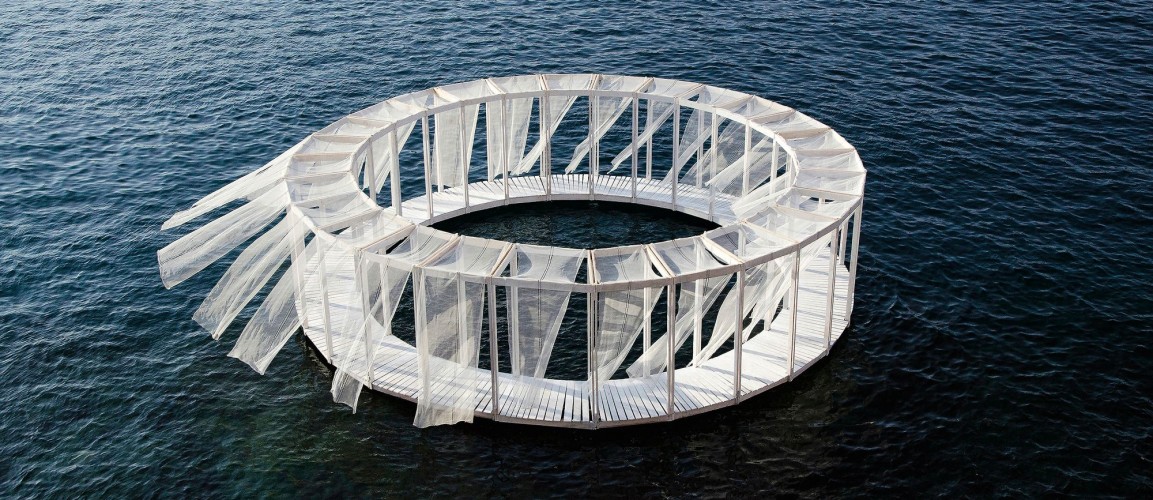
Do Ho Suh (born Seoul, South Korea, 1962). The Perfect Home II, 2003. Translucent nylon. Brooklyn Museum; Gift of Lawrence B. Benenson, 2017.46. (Photo: Courtesy of the artist and Lehmann Maupin Gallery)
In 1968, Jean Baudrillard in his book “The System of Objects” referred that “the atmospheric interior is designed to permit the same alternation between warmth and non-warmth, between intimacy and distance, to operate not only between the objects that comprise it but also between the human beings who live in it”.[2] The dialogue has now shifted more to when actions and situations that naturally originate from the individuals themself contribute to the acquisition of an atmospheric dimension of a space. Focusing on the individual's identity is also the key to designing, selecting and consuming items. That way, design decisions are not only what seemingly can meet the interior’s standards and functionalities that we all more or less have in mind, but instead create atmospheres and even more social trends and attitudes. Therefore, since everything starts from a design initiative, we understand that when the designer contributes, emphasizes and approaches the social-critical and political aspects through the design, we can talk about a successful design that respects the users, meets their needs and finally inspires them.

403 Architecture, THE DIFFERENCE OF EBITSUKA, JAPAN – HAMAMATSU, 2011, (photo by Kenta Hasegawa)
Consequently, when the design exists under the prism of mass production and does not focus on the individual, the usability and quality of the design can be challenged. Standard lay-outs often weaken the user by limiting creativity and intimacy, elements that no doubt a domestic environment should preserve. But, beyond floor plans, smaller objects such as furniture or appliances can also trap or distract the user. Overexposure to information and the massive availability of new objects as well as the over consumerism that is often driven by perhaps a trend, can actually create vague, if not blurred, interior spaces that consequently would affect the functionality of space and project control over the users’ space, in turn preventing the development of truly atmospheric spaces that help the individuals intensify the intimate features within the domestic environment. The designer should enlighten these aspects and inspire and actuate the individuals to realize what really expresses and satisfies them. All this must be the driving force of a nowadays design action.
Mary Farwy, an architect and designer based in Amsterdam, created a graduation project for Royal Academy of Art in the Hague with the title Care Water Closet (CWC) in which she used the normativity of human behavior as a starting research point. She focuses on the toilets and its spatial-psychological values that have been unhighlighted for years. “The CWC gets rid of the flush system and recycles the grey domestic water using solar energy, into clean water. Fertilizers are extracted too. The CWC is mobilized with self-care tools such as a breathing device and a care clock. To stop care from being personal, the care agents are part of the CWC scenario too”, she notices. Undoubtedly, what we should be concerned with now is how we plan for care and not for development, reconsidering the limits of design and of normality, creating new principles and values that the future world demands.

Mary Farwy (b. Syria, 1992), CARE WATER CLOSET 2020
“Human beings and objects are indeed bound together in a collusion in which the objects take on a certain density, an emotional value - what might be called presence. What gives the houses of our childhood such depth and resonance in memory is clearly this complex structure of interiority, and the objects within it serve for us as boundary markers of the symbolic configuration known as home”.[3]
Georgina Pantazopoulou is an interdisciplinary artist and architect graduated from the Architecture Department of University of Patras. Currently she is completing her MA in Royal Academy of Art in the Hague. Her research is based on the gender roles within domestic environments, using a feminist approach in order to redefine them under the prism of intersectionality. She is working with installations, participatory performances, videos, drawings and words.
[1] Rosi Braidotti, The Posthuman, Polity Press, Oxford, United Kingdom, 2013, p. 59
[2] Jean Baudrillard, The System of Objects, original published 1968, Verso Books, London, 2020, p. 43
[3] Jean Baudrillard, The System of Objects, original published 1968, Verso Books, London, 2020, p. 14